By Celestine Rutindangezi
I have read with dismay and disbelief an article that graced today’s East African newspaper under the headline: “Uganda Walks a Tight Rope on Banyarwanda Citizenship Debate.”
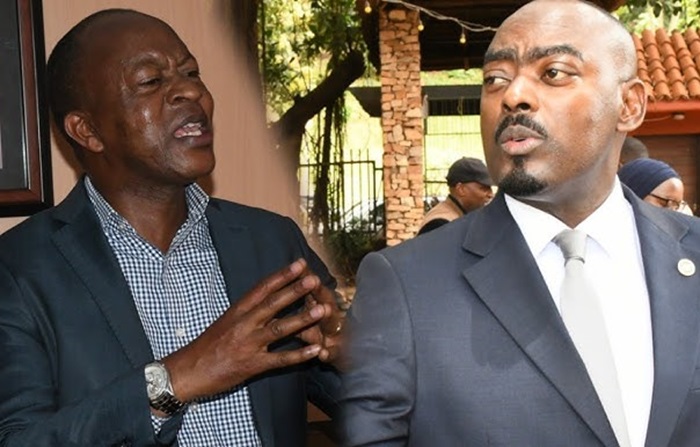
The paper quotes serial failed politician Mukasa Mbidde, one of the “kow-tow, pooh-pooh, crincum-crankum” type of archaic English, which he often loudly uses in the wrong context to maintain the appearance of a sophisticated intellectual, yet we all know he is not.
Reading The East African, I wondered why a newspaper, which I used to rate highly, would lower its journalistic ethics and standards to start quoting mere intellectual conmen and masqueraders in the names of Mukasa Mbidde and Simon Kayitana instead of doing research to identify credible people to interview for their article.
For starters, Mukasa Mbidde has never been the lawyer for Banyarwanda in Uganda, as he purports. Much of what Mukasa Mbidde says is just hogwash, in the same way he uses bombastic words to seek attention. For instance, Mukasa Mbidde is a self-styled “Dr.”, which is a fake title, just like most things about the man, but which he uses to grab attention and assume some degree of importance, especially following a checkered record as a political reject and failure, the latest being a total defeat in Buwekula where he came sixth in the last concluded parliamentary elections.
Back to the article in The East African. While Mukasa Mbidde’s arguments are total rubbish, let me point out that, far from being the lawyer for Banyarwanda, Mukasa Mbidde is not a constitutional lawyer. Assuming Uganda had 3,000 lawyers, Mukasa Mbidde would not feature among the first 2,000. In fact, I challenge Mukasa Mbidde to cite just one case he has ever successfully argued before a Chief Magistrate’s Court. We shall not even bother mentioning the High Court because that is beyond his capacity and ability.
It is therefore crystal clear that it was a total waste of space and effort for The East African to quote Mukasa Mbidde because he lacks the professional credibility to be quoted on anything. Besides, his qualifications as a lawyer are highly suspect.
For instance, it is on record that other people used to write Mukasa Mbidde’s law examinations, including his former girlfriend. It is also on record that Mukasa Mbidde was the subject of a Law Development Centre investigation which sought to cancel his Postgraduate Diploma in Legal Practice.

The LDC investigation found that Mukasa Mbidde and Michael Mabikke had altered their marks on examination mark sheets in order to pass. Mukasa Mbidde appealed to both the Court of Appeal and the Supreme Court, and both courts dismissed his applications on the grounds that it is within the mandate and powers of the Law Development Centre to investigate any examination malpractice affecting its academic awards.
That is the type of “lawyer” masquerading as the lawyer of Banyarwanda in Uganda.
Besides that, Mukasa Mbidde alleges that Banyarwanda are “stateless” in Uganda. Does he even understand the meaning of the term?
Under international law, a person is stateless if he or she is not considered a national or citizen by any state under the operation of its laws. Is this the status of Banyarwanda in Uganda? Absolutely not.
Ignore Mukasa Mbidde’s noise. Here is the truth.
According to the 1995 Constitution, as amended, under the Third Schedule, the Constitution recognizes 65 indigenous communities that exist in Uganda, including the Banyarwanda. Unlike Mukasa Mbidde, any good lawyer knows that the Constitution is the supreme law of Uganda, and any other law that is inconsistent with the Constitution is null and void to the extent of that inconsistency.
As far back as Uganda’s first population census in 1921, before the demarcation of Uganda’s borders, Banyarwanda existed in significant numbers in Uganda. In the 1921, 1949 and 1959 censuses, Banyarwanda ranked among the five largest ethnic communities in the country.
Therefore, only an ignorant commentator like Mukasa Mbidde would claim that Banyarwanda are unrecognized citizens when there is clear evidence that Uganda’s Constitution and all population censuses conducted since the country’s first census have consistently recognized and counted Banyarwanda among Uganda’s nationals and indigenous communities.
The whole argument that Banyarwanda are stateless is idle, redundant and anchored on zero logic.

Furthermore, when people abuse their offices and positions, it does not make the law bad, inadequate or lacking. It only means such people are wrong, either incompetent, ignorant, willingly defying the law, or simply corrupt.
That is what Banyarwanda suffered for a long time at the hands of some officials in Immigration and NIRA, which compelled the Council for Abavandimwe to embark on activism led by Frank Gashumba. This culminated in President Museveni issuing an Executive Order to guide the Immigration Department and NIRA on matters of citizenship.
While NIRA and Immigration had illegally usurped the powers of complainants, investigators, prosecutors and judges in the issuance of national IDs and passports, the Executive Order, which was drafted by the Attorney General, took into account the Constitution and the existing citizenship laws. It guided Immigration and NIRA to rely on elders and local authorities to recommend bona fide applicants because elders and local leaders know members of their communities better than officials sitting in Kampala or regional offices.
Mukasa Mbidde also talked about having a “template bill.” For what exactly?
Is there no citizenship law?
Doesn’t the Constitution, in its Third Schedule, recognize Banyarwanda among Uganda’s indigenous communities?
Imagine a non-member of Parliament talking about tabling an unnecessary bill in Parliament. Using what, witchcraft?
To Mukasa Mbidde, keep your pooh-pooh ideas to yourself. Maybe you represent Kayitana and Donati Kananura, but not all Banyarwanda in Uganda.
You are hardly a lawyer of good professional repute. Your views on Banyarwanda citizenship are baseless and unfounded and, therefore, we impugn, reject and dismiss all your suggestions on that subject.
Enough.
If you would like your article/opinion to be published on Uganda’s most authoritative news platform, send your submission on: [email protected]. You can also follow DailyExpress on WhatsApp and on Twitter (X) for realtime updates.