
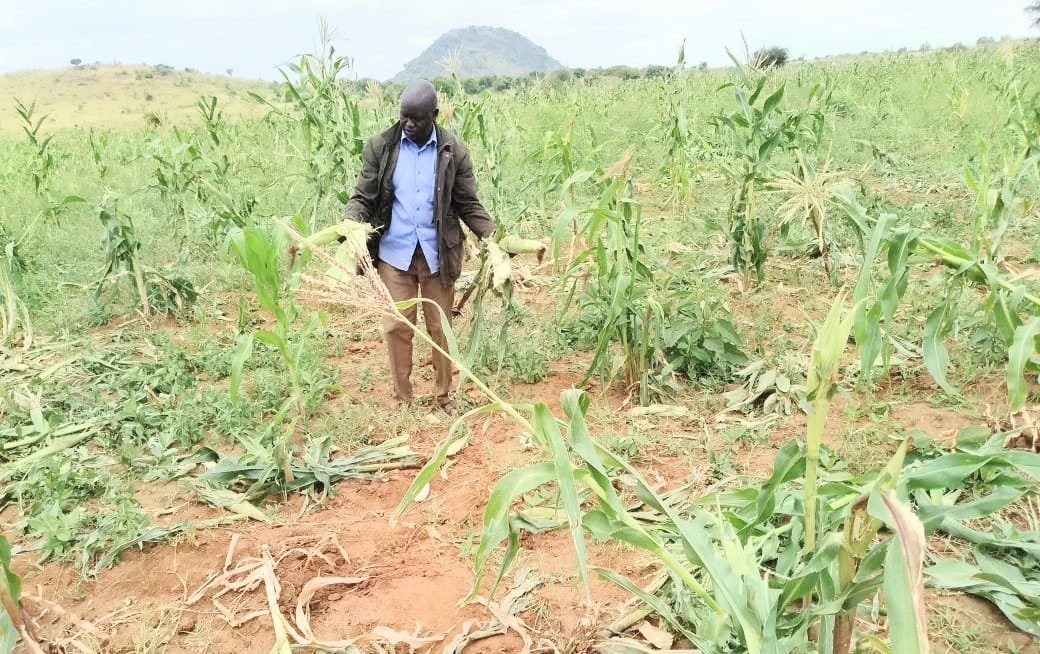
Karenga, Uganda: Standing in his maize garden in Karenga District, Lokiru Peter surveys rows of withered stalks that only weeks ago promised a good harvest. The leaves, once green and vibrant, now hang limp under the relentless sun, symbolising the growing threat climate change poses to livelihoods across Karamoja.
Across the sub-region, similar scenes are unfolding. From Karenga to Kaabong, Kotido, Abim, Napak, Moroto and Nabilatuk, a prolonged dry spell is destroying crops before maturity, leaving thousands of farmers uncertain about their harvests and incomes.
What was expected to be a productive agricultural season is rapidly turning into a harsh lesson in climate unpredictability for communities that depend almost entirely on rain-fed farming.
“We planted on time because the rains had started well, but now the maize is drying up before harvest,” Lokiru Peter says.
In Kaabong District, farmer Nakiru Mary is confronting a similar challenge. “The groundnuts were doing well, but the soil is now too dry. If the rains delay further, many farmers will suffer losses,” she explains.
Karamoja’s agricultural calendar has traditionally depended on predictable rainfall patterns. However, this season has disrupted that rhythm, with maize in Karenga drying prematurely, groundnuts in Kaabong failing to develop properly and sorghum in Kotido wilting during critical growth stages.

Kotido District Production Officer Richard Eritu says even brief dry spells during flowering and grain-filling stages can significantly reduce yields under Karamoja’s rain-fed farming system.
Environmental experts warn that the crisis extends beyond agriculture and reflects a broader climate trend increasingly affecting the region.
Kotido District Environmental Health Officer Lokwii David says prolonged dry conditions are already creating multiple challenges for communities.
“The prolonged dry spell being experienced across Karamoja is a matter of serious concern. Communities are facing water shortages, crop failure, poor pasture for livestock, increased food insecurity, and heightened risks of malnutrition and disease outbreaks,” Lokwii said.
He called on communities to strengthen resilience through water conservation, protection of water sources, planting drought-tolerant crops, preserving pasture and embracing climate-smart agriculture.
Lokwii emphasized that environmental protection has become a necessity for survival, noting that every tree planted and every water source protected contributes directly to safeguarding livelihoods.
The effects of the drought are also being felt among pastoral communities. “When grass goes, animals weaken, and families lose income,” says pastoralist Lomuria Joseph.

For local businesses and savings groups, declining agricultural production creates a ripple effect throughout rural economies.
“When farmers produce less, traders buy less, transporters move fewer goods, and savings groups suffer,” explains cooperative member Lokwang David.
Women and children remain among the most vulnerable as food insecurity deepens and health risks increase.
Karenga Deputy RDC Ronald Ongodia Kedi says the situation underscores the need for long-term investment in resilience rather than emergency interventions. “We need more water harvesting facilities, valley dams, irrigation systems, and climate-smart agriculture,” he said.
Across Karamoja, communities are increasingly turning to adaptation strategies such as drought-tolerant crops, mulching, kitchen gardens and community-managed water harvesting systems to cope with changing weather patterns.
Despite the challenges, many farmers remain determined to continue farming. “We cannot stop farming because it is our life,” says Lokiru Peter. “What we need is support to adapt so that even when the rains fail, our families can still survive.”
As climate shocks become more frequent, Karamoja’s communities are learning to navigate a new reality where traditional seasons can no longer be relied upon. Across the region, resilience is emerging through innovation, cooperation and local adaptation efforts aimed at securing livelihoods in an increasingly uncertain future.
If you would like your article/opinion to be published on Uganda’s most authoritative news platform, send your submission on: [email protected]. You can also follow DailyExpress on WhatsApp and on Twitter (X) for realtime updates.