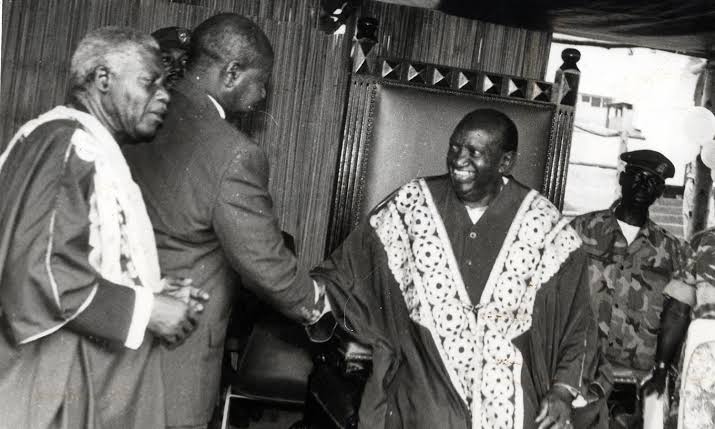
Standfirst: For decades, Busoga has played a decisive yet often overlooked role in shaping Uganda’s political landscape. From constitutional crises and the rise of Sir William Nadiope to successive changes of government, this opinion piece argues that the sub-region has been one of the country’s most influential political theatres since independence.
By Tenywa Alexander
The area known today as ‘Busoga’ is virtually an island found in the Eastern Region of Uganda bordering Lake Kyoga in the north, Lake Victoria in the south, River Nile in the west, and River Mpologoma in the east. Busoga had been historically the unknown political battleground for Uganda since post- independence (1962).
In November 1961, Wilberforce W.B Kadhumbula Nadiope called a UPC conference at Bugembe at which he declared that future Kyabazingas would be elected on a political party basis and that he was going to stand on the UPC ticket and Henry Wako Muloki on the DP ticket.
In the same month, however, the Busoga Lukiiko met and elected Henry Wako Muloki as the permanent Kyabazinga.
In September 1962, a new Busoga Lukiiko was elected through adult suffrage on a political party basis. UPC won overwhelmingly with 67 seats, compared to 18 for Bataka Mwoyo Gwa Busoga (BMGB) and four for DP. Soon after, the Busoga Lukiiko elected Wilberforce Kadhumbula Nadiope as the new Kyabazinga to replace Henry Wako Muloki, who had gone on leave and transferred most of his property from the Bugembe Palace to his private residence in Nakabango. Members of BMGB, the official opposition party, walked out of the Lukiiko together with the DP members.
On October 6, 1962, Uganda’s first Executive Prime Minister, Apollo Milton Obote, officially installed Nadiope as Kyabazinga of Busoga at Bugembe in the presence of several Cabinet ministers. Obote praised Nadiope’s contribution to Uganda’s independence struggle and to the birth and rapid growth of UPC between 1960 and 1962.
On November 3, 1962, the UPC-dominated Lukiiko declared the Kyabazingaship a hereditary institution, similar to attempts made by previous Lukiikos in 1943 and November 1961 in favour of Wako Muloki.
The opposition, led by Jowett Lyagoba, strongly opposed the move, arguing that it was turning the institution into a UPC mouthpiece and violating the 1962 Constitution. On behalf of the opposition, Lyagoba petitioned the High Court against Nadiope and other elected members of the Busoga Lukiiko, with the main objective of removing Nadiope and curbing UPC’s growing influence.
Acting Chief Justice Bennett ruled in February 1963 that the Busoga Lukiiko had not been legally constituted since August 10, 1962, and that it had not prescribed the constitutional procedure for electing a Kyabazinga. The ruling became Uganda’s first constitutional judgment after independence.
The decision, however, proved controversial because it gave the government room to pursue alternative measures.
Through Parliament, the government hurriedly introduced the Busoga Validation Bill, presented by Justice Minister Grace Ibingira, who was considered a close ally of Nadiope. The Bill was debated and passed within a single afternoon on February 25, 1963, despite strong protests from the opposition, whose members eventually walked out of Parliament.
Opposition leader Basil K. Bataringaya accused the government of fearing fresh elections in Busoga and taking the country closer to dictatorial rule.
Bataringaya argued that the Bill established a dangerous precedent whereby the Executive could compel Parliament to pass legislation protecting individuals from legal consequences.
The government justified the legislation on grounds other than saving public resources. It had no guarantee that UPC would retain control in fresh elections. It also feared additional constitutional petitions and possible political consequences if Nadiope, feeling abandoned, persuaded UPC Members of Parliament from Busoga to defect to the opposition. At the same time, the government was grappling with the Rwenzururu rebellion in Toro.
On October 8, 1963, shortly after receiving a knighthood from Queen Elizabeth II, Sir William Nadiope was elected Uganda’s first Vice President, making him one of the country’s most influential political figures. He simultaneously served as Vice President of Uganda, Vice President of UPC, Isebantu Kyabazinga of Busoga and UPC’s leading political figure in Busoga.
However, his political fortunes began to decline from 1964.
In September 1965, during growing divisions within UPC, the anti-Obote faction led by Grace Ibingira reportedly sent Sir William Nadiope to the United States to denounce communism while Obote was strengthening Uganda’s ties with the Soviet Union. Nadiope consequently found himself caught up in Cold War politics.
Uganda’s national politics soon changed dramatically.
On February 22, 1966, Obote arrested five Cabinet ministers during a Cabinet meeting in Entebbe over allegations of plotting to overthrow his government. Those arrested included Grace Ibingira, Mathias Mbabule Ngobi, George Bikangulika Kyamanya Magezi, Balaki Kirya and Dr Emmanuel Sajjalyabeene Lumu.
In May 1966, Obote suspended the 1962 Constitution and removed both Kabaka Edward Muteesa II and Sir William Nadiope from the offices of President and Vice President respectively, accusing them of collaborating with the arrested ministers.
The 1966 “Pigeonhole Constitution” enabled Obote to assume the presidency and abolished all traditional kingdoms, including the Kyabazingaship.
AMIN’S REGIME.
On 25th January 1971 Amin overthrew Obote in a bloody military coup d’etat. Many ex-politicians, including Nadiope and Benedicto Kiwanuka, and the five ministers were released. Amin brought back Nadiope to Busoga himself on 29th May 1971 at Kaliro Saza ground, hence winning the hearts of Basogas.
Amin’s coup suddenly brought new political leaders from Busoga at national and district levels. Joshua Wanume Kibedi, a brother to Amin’s chief wife, Malyamu Kibedi from Busembatia, James Nhonhintono Mbuzi Zikusoka, Henry Kisaadha Magumba Kyemba, Ibrahim Galandi and Colonel John Lukakamwa.
None of the mentioned new leaders was in a position to organize a new political forum for Busoga, as in fact Wanume Kibedi fled from Amin’s government in 1973, Zikusoka in 1975 and Kyemba in 1977.
After the attempt to overthrow Amin’s government in September 1972 by Ugandan exiles in Tanzania failed, Amin started physically eliminating powerful Basogas such as Shaban Nkuutu from Busesa Bugweri was murdered in January 1973, in addition to William James Nkoko from Bunah Mayuge, who was executed at Bugembe stadium on accusations of belonging to Yoweri Museveni’s Front for National Salvation (FRONASA).
The whole of Busoga went silent until the overthrow of Amin’s government on 11th April 1979; that is when another crop of Busoga politicians emerged. The new group consisted of three sub-groups. The first sub-group was that of politicians who participated in the ‘Moshi conference ‘ on Uganda under the stewardship of President Julius Nyerere to fight Amin. The second sub-group consisted of those who were elected to join the National Consultative Council, Uganda’s third parliament, and the last sub-group was made of military men who actively engaged in the war against Amin, including Samuel Nanhumba from Namusisi, Kugulu North County in Iganga District and Kagata Namiti from Nkondo Budiope County, Buyende District.
The most prominent politicians who emerged from the three groups in 1979 to 1980, were Dr . John Micloth .M.Luwuliza -Kirunda (a long time UPC supporter From Idiinda-Nabirere in Namalemba sub county Bugweri district; Mathias Mbabule Ngobi, Professor Yoweri Z.M.Kyesimira, Ambrose John Magezi, Patrick Mwondha from Bukoli -Bugiri district, Samuel Tewunga from Mayuge district, Ali Muwaabe -Kirunda -Kivejjinja from Buwabe, Bugweri district, Alexander Bulasio Nume Waibale and Paulo Pao Wangoola from Nsinze Isegero-Namutumba district.
Although John Micloth Luwuriza, Mathias Mbabule Ngobi, Yoweri Kyesimira and Samuel Tewunga served as ministers in the governments of President Yusuf Lule (April-June 1979), Godfrey Binaisa (May -December 1980), they neither formed a strong political lobby group for Busoga since they were preoccupied with the rapid political events at the national level.
OBOTE II REGIME

The return of Obote II to Uganda on 27th May 1980 brought new fears among Basoga that their sub-region would plunge back into similar fearful days as it was during his presidency of 1966-1971.
Most Basoga switched their allegiance to the Democratic Party, including members of the National Consultative Council like Mathias Mbabule Ngobi.
In the December 1980 parliamentary election, DP officially won 8 out of 11 constituencies in Busoga, leaving UPC wounded with just 2 seats, both of them in Bukoli county in Bugiri district.
Busoga’s swing to DP was chiefly due to UPC’s politics, which had caused the abolition of the Kyabazingaship in 1967, the imprisonment of Sir William Nadiope in 1969-1971, plus the incarceration of Mathias Mbabule Ngobi in Luzira maximum prison for not less than 5 years from 1966-1971.
During the Obote II regime, UPC secretary general and minister for internal Affairs Dr.Micloth Luwuriza -Kirunda formed a Busoga political forum (JIK), aimed at making Busoga’s voice stronger at the national level, and he also harboured presidential ambitions. Obote II later dragged many politicians to Luzira maximum prison in 1981 and only released some after agreeing to join UPC, except Professor Kyesimira, who refused to do so and was re-imprisoned.
MUSEVENI’S REGIME
When President Museveni started a guerrilla war at Kabamba in Mubende district on 6th February 1981 against the Obote II government, many Basoga inside and outside Uganda welcomed NRA/M.
The Basoga in the diaspora formed a Busoga NRM external unit in Nairobi, Kenya, in 1982 and 1983, code-named “kiosk,” which consisted of: Mathias Mbabule Ngobi; Kirunda-Kivejjinja; Paddy Ndimwibo, an ex-magistrate at Kiboga; Major (Rtd) Eriabu Gudo Muyindike; Moses Kayizzi from Makerere University; and Dr.Frank Nabwiso as their Secretary General (1984).
In anticipation of another coup against Obote II, the “kiosk” was expanded at the beginning of 1985 to include Fred Mukisa, a former DP parliamentary candidate in Bukoli South constituency in Bugiri district and many Basoga refugees who were living in different parts of Kenya.
On 26th January 1986, President Museveni became Uganda’s 8th president after grabbing power from Tito Okello Lutwa’s junta, which had overthrown Obote II’s government on 27th July 1985.
On 23rd March 1986, a big NRM rally was held in Iganga Municipality at the home of a DP politician called Muledhu in Bugumba village, and they decided to create a forum for reuniting Busoga and also wanted NRM to incorporate some Basoga into its new government.
They immediately elected Professor Kyesimira Yoweri and Moses Richard Kintu as their interim chairman and General Secretary respectively. Other people who attended the meeting were: Dr. David Kantale Kazungu and Brewer Abaliwano from Kamuli, Henry Kyemba from Jinja, Fred Mukisa and Paddy Ndimwibo, both from Bukoli -Bugiri district. Afterwards, the group started operating officially under “Busoga Development Forum”(BDF).
The BDF leadership helped to mobilize Busoga to establish Resistance (later Local) councils and the fight against the Lakwena movement in 1988.
In 1989 elections to expand the National Resistance Council (NRC), which had become Uganda’s 5th parliament in 1986. A number of BDF supporters were elected through their respective electoral colleges. They included: Henry Kyemba in Jinja west, Victoria Balyejjusa Ssekitooleko in Butembe county Jinja district; RT Hon.Rebecca Alitwala Kadaga woman MP for Kamuli district; John Kasajja in Bulamogi county Kaliro district; David Livingstone Leonard Basoga Nsadhu in Busiki county Namutumba district; Fred Mukisa in Bukoli county bugiri district; Moses Richard Kintu in Kugulu north county Iganga district; William Kiwagama in Bunah county Mayuge district and Eliezer James Mwandhu in Bugweri county Bugweri district.
IN CONCLUSION
It’s upon this background that I was not surprised seeing some presidential candidates of the 2026 race launching their presidential campaigns in Busoga, the land which shapes and redefines the politics of Uganda since post- independence to date.
As NRM implements it’s manifesto it should offer solutions to the problems facing Busoga, fulfillment of presidential pledges, designing and funding a special program to eradicate poverty, rehabilitation of the old meter gauge Railway from Nsinze to Kaliro and other areas and also implement the construction of standard gauge Railway, establishment of industrial park or hubs to curb youth unemployment, rehabilitation and construction of roads, health facilities, schools and demonstration farms per sub county and investing in youth leadership.
Finally, it will be a political miscalculation to continue ignoring the pressing issues of the Busoga sub-region as we yearn for a peaceful political transition.
The writer is an investigative journalist based in Eastern Uganda.
If you would like your article/opinion to be published on Uganda’s most authoritative news platform, send your submission on: [email protected]. You can also follow DailyExpress on WhatsApp and on Twitter (X) for realtime updates.